
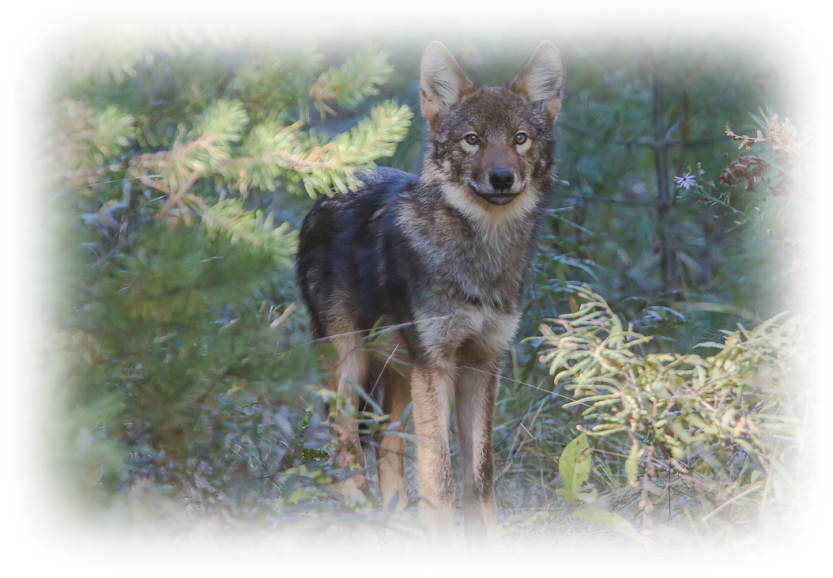
Eastern Wolf Image Credit: Michael Runtz, CC BY 4.0 <https://creativecommons.org/licenses/by/4.0>, via Wikimedia Commons

In the great forests of Maine, my home state, the wolf population is completely eradicated. Today there are coyote-wolf hybrids, but Eastern Wolves have not roamed our woods and shores for more than a century. In the early 1800s, coastal sheep farmers put bounties on their heads until there were none left.
The northeast’s historical violence against wolves comes from our perception of them as viscous beasts, according to Barry Lopez in his book Of Wolves and Men. Lopez explains that wolves have always symbolized our most base fears of the wilderness, just as portrayed in Grimm’s fairytales and Aesop’s fables.
Conquering the wild
Colonial settlements often had livestock grazing without any fencing or other protection, pastures blending into the wild landscape all around them. In their quest for survival, settlers tried to conquer the wild by dominating and killing the wolf from the shores of the northeast to the mountains of the west.
As timbermen and barkskins leveled the old growth forests of early America, clearing great tracts for farmland, they decimated the wolf populations. The government even had a hand at their eradication as late as 1937 when they hunted down entire packs with helicopters and rifles and advised ranchers how to kill pups in dens.
Our collective conscious
The wolf’s reputation as a vicious killing monster is a part of America’s collective conscious. According to historian Jon T. Coleman, author of Vicious: Wolves and Men in America, our entire culture was violent toward wolves for several centuries to “invert” or overturn the new world from wilderness to order. From baiting and trapping to shooting and poisoning, hunters nearly exterminated them in the lower 48 states.
When colonists faced any kind of savage, whether human or animal, they created stories giving them permission to lash out against this enemy, whether the savagery was against their livelihood or their livestock. Much like the Native Americans they encountered, wolves posed a threat to survival.
Manifest Destiny
Humans and wolves are known as apex predators, competing for food and territory throughout history. The early settlers fight against wolves was a Darwinian struggle for the survival of the fittest, bringing to light this county’s long held motives of capitalism, nationalism, expansionism, and Manifest Destiny.
But when a species is removed from an environment, it can have devastating consequences on an entire ecosystem, disrupting the natural order and web of connectedness. Today, there is a shift toward protecting wolves and reintroducing them, but ranchers and other owners of livestock disagree with these protections or virtually any oversight and overreach by the federal government.
Wolf conservation today
As of 1978, the gray wolf finally gained protection under the Endangered Species Act, a giant step in wildlife conservation. Looking at our history from the perspective of environmental losses like the great wolf populations of our early American forests creates a kind of hindsight. We can look back with a new clarity that some may call 20/20.
“Wolves Are Still With Us,” by Philip Conkling | Down East Magazine
The Wolf That Changed America | Wolf Wars: America’s Campaign to Eradicate the Wolf | Nature | PBS
Leave a Reply