
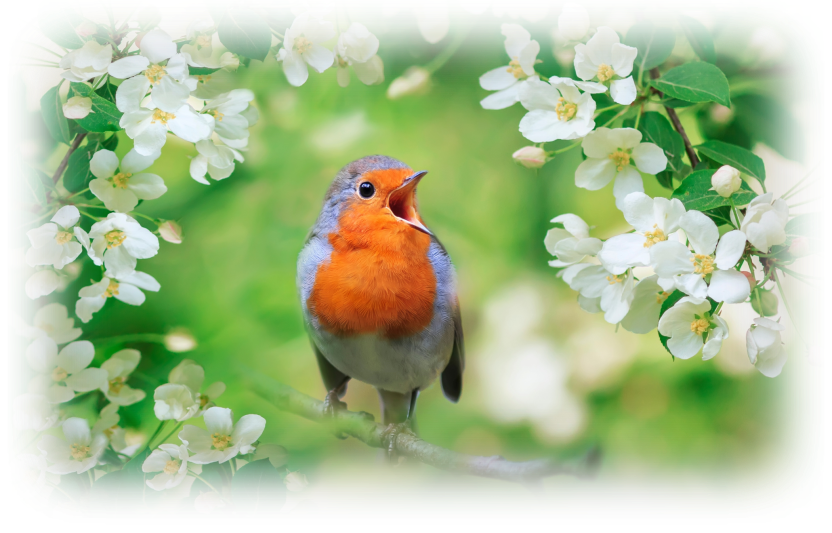
Image Credit: Bachkova Natalia at Shutterstock 2259151695
We all know the magic of spring when birdsong miraculously fills our mornings during the warming weather. Their sophisticated and poetic singing is just one of the remarkable talents that birds have fine-tuned over thousands of years.
Flighty barometers of change
Birds are indeed a harbinger and a barometer to the changing planet. A recent Science study found that the number of species has fallen significantly over the past 50 years—a decrease of nearly three billion birds since 1970. Changes in ecosystems, and in normal cycles of light and noise, threaten their survival.
Like humans, our feathered friends rely on sharp senses—including vison, hearing, feeling, magnetic, and echolocation—to survive. In the springtime, mating songs fill the air, along with calls of danger. From miles overhead, they can spot a fish and even sense the air pressure of a weather change.
Eagle eye vision
Birds of prey, like eagles and hawks, have large powerful eyes and remarkable long-distance binocular vision. They are incredibly adept at sighting prey, as far away as two miles, and inherently knowing the distance. Nocturnal birds of prey, like the owl, can see in very low light for hunting at night.
For the most part, birds are diurnal with sharp daytime vision. They also have exceptional color vision, and many have tetrachromatic sight, giving them the ability to see ultraviolet light. Their UV vision helps them find food and see details of another bird’s plumage—invisible details to us mere mortals who see in the three primary colors.
Whoo-Whoo-Whoo can you hear?
From a horned lark sensing a rodent in the long grass to a house sparrow hearing an insect in a leaf pile to an owl tracking a rabbit underneath a foot of snow, a bird’s hearing is developed for survival.
Their ears sit below and behind their eyes, usually covered with feathers. They pick up vibrations through their eardrum, sending the pulse to the nerve that delivers signals to the brain. Birds can also detect air pressure, giving them an extrasensory perception of weather changes.
Their songs express a range of emotions from alarm to aggression that only other birds can interpret. We are only beginning to understand the many complicated ways that our feathered friends can communicate with one another and the complexity of their songs.
Sensitive feathers and beaks of duck, duck, goose!
Feathers not only keep birds warm and protected, but also help them navigate. The movement of feathers against the skin helps them sense their position in the sky or water. When you see a goose preening, it is not just for show or to dry their feathers, but also to position feathers for flight.
Species like shore birds and waterfowl have extra sensitive bills, allowing them to sift through the mud for morsels or filter food in the water. They can even sense vibrations in the soil and the water through their extra-sensitive beaks for signs of hidden insects or tiny organisms.
The great albatross migration
Perhaps the most impressive sense is a bird’s ability to detect magnetic fields. With their specialized retinas, they can see the magnetic field mapping the earth. By understanding where the north and south poles are, they can find their way back to spawning and nesting grounds, essential for their annual migrations.
The albatross and petrel can travel thousands of miles over the open ocean, relying on their magnetoreception, in combination with their keen senses of smell and sight, to find their way to nesting or breeding or feeding grounds on their long journeys from the Arctic to the Antarctic.
Batty echolocation
Species like bats can sense objects around them using sound. They produce ultrasonic wavelengths that bounce off objects, echoing the sound back to them. From large obstacles like trees to small prey like insects, echolocation allows them to navigate and feed in complete darkness. Bats can mark the exact location and size of other animals or objects around them for survival.
Confusing environmental signals
Birds have adapted their senses to navigate unique natural environments. What happens if the environmental signals they rely on for survival begin to change? Even minor habitat changes in our shared world can cause harm.
Humans create lots of light and noise, signals that birds depend on to forage, hunt, breed and nest. When there is too much light in the atmosphere, birds can misinterpret important seasonal changes and signals, altering everything from migration patterns to breeding and nesting cycles.
In forested areas, birds are affected by noise pollution because they rely on their vocals to carry through the vegetation. The noise or frequencies we create can dampen natural bird songs and calls, interrupting the important signals for breeding and nesting they depend on for survival.
Human interference
Whether we’re creating light pollution in our city buildings or suburban backyards, we are impacting the lifecycle of our feathered friends. Birds depend on the natural signals of day and night, which can also affect the insects they feed on. To maintain a more natural nighttime habitat at home, we can install smart light motion-detectors and use lower, softer (yellow light) LEDs.
New technologies and human innovation can also reduce noise. We can drive quieter electric vehicles or create vegetation on the roadside to keep wooded areas naturally silent. Restoring natural light and noise levels will help ensure that birds pick up the right signals at the right time.
Warnings of a silent spring
Thanks to the biologist Rachel Carson (1907 – 1964), we understand the harms of pesticides. Back in 1962, she published Silent Spring, a book that changed the course of history. During a time when humans were laying down a barrage of poisons on the earth, she warned us about the dangers of the widespread use of DDT and other pesticides.
Carson became the biggest change-agent to the environmental movement, cautioning us to come to terms with nature—to work with it, not against it. At the time, she was condemned as a spinster and communist. She turned out to be a revolutionary, waking a nation to the dangers of chemicals.
Today, we can continue her legacy by changing our own behaviors for a more inclusive and healthier planet. Long live the birdsong!
Sources:
Sensory Perception in Birds: Understanding Their Senses | Birdfact
Bird Senses…How Do They Experience The World? (weknowbirds.com)
How Unnatural Light and Noise Affect Birds (treehugger.com)


Leave a Reply